


Really appreciate the information you shared. It’s extremely useful!
https://www.debrajshome.com/best-cheek-augmentation-treatment-mumbai-india/

Published on 16 June 2024
Fact checked
Cheeks play a crucial role in defining our facial structure, contributing to our overall appearance and symmetry. They provide contour, shape, and balance to the face, framing the eyes and accentuating the jawline. However, as we age, the natural fat pads in our cheeks may diminish, resulting in a loss of volume and firmness. This can lead to a sunken or hollow appearance, making us appear older or more tired than we feel.
Recognizing the significance of cheeks in facial harmony, many individuals seek cheek reshaping procedures to restore youthful fullness, enhance facial symmetry, and achieve a more balanced profile. Whether desiring subtle enhancements or dramatic transformations, people turn to cheek augmentation to address various concerns, such as flat or undefined cheeks, asymmetry, or simply to achieve the coveted high-cheekbone look.
By understanding the importance of cheeks and how they contribute to our facial aesthetics, individuals can make informed decisions about undergoing cheek augmentation procedures to achieve their desired look and enhance their overall appearance. Join us as we delve deeper into the world of cheek augmentation and uncover the transformative possibilities it offers.
Cheek augmentation is a cosmetic procedure involving injectable fillers, implants, or fat transfer to enhance the appearance of the cheeks. The goal of the procedure is to add volume and definition to the cheeks. The process can be done in a doctor's office or clinic and typically takes 30 minutes to an hour to complete.
Good candidates for cheek augmentation include people who have lost volume in their cheeks due to aging, those with naturally flat or undefined cheeks, and those who just want to have more prominent cheeks for cosmetic reasons. The procedure can be performed on both men and women and tailored to suit individual facial features.
Candidates must be in good overall health, with no medical conditions that might complicate the procedure.
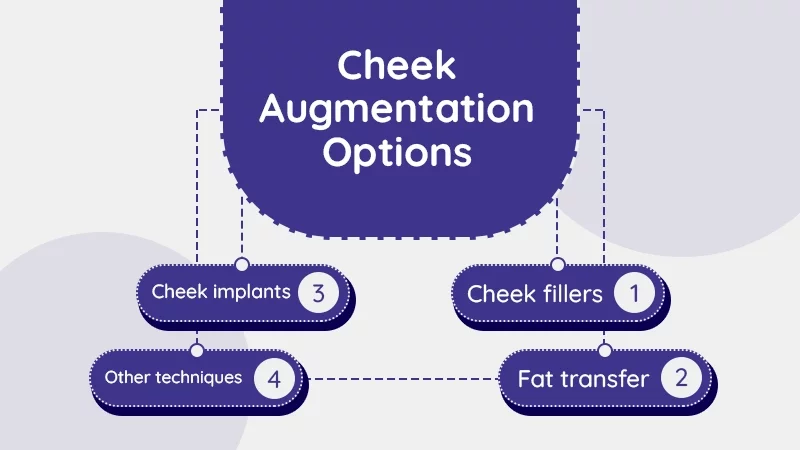
There are several types of cheek augmentation procedures, including:
Many products are available for adding volume to the mid-face area. These include collagen fillers, fillers that give volume like hyaluronic acid, and fillers that help your body grow new tissue like calcium hydroxyapatite and poly-L-lactic acid. The effects of the fillers are temporary, lasting between 6 to 18 months, and require maintenance.
Injectable fillers are typically done in a doctor's office or clinic. The procedure begins with applying a numbing cream or local anesthesia to minimize discomfort. The filler is then injected into the cheeks using a fine needle. The procedure normally takes 30 minutes to an hour to complete.
Also Read: cheek fillers
Fat transfer or fat grafting is a technique in which fat is removed from one part/area of the body, mostly from the stomach or thighs, and then injected into the cheeks. Fat grafting is an attractive cheek augmentation technique due to its customizability, biocompatibility, low cost, and abundance of fat in most people.
Fat grafting typically involves three stages: harvesting adipose tissue (fat) from the donor site, processing the fat to remove cellular debris, oil, and excess fluid, and reinjection of the purified fat in the cheeks. The injected fat is then sculpted to create a more youthful and defined appearance. It usually takes 2-3 hours to complete the procedure under local anesthesia.
Also Read: fat transfer
Facial implants are widely used to enhance the contours of facial features, including the cheeks. The most common types of cheek implants are silicone, Medpor (high-density porous polyethylene), and Gore-Tex (expanded polytetrafluoroethylene). Cheek implants are permanent and can provide more long-lasting results.
Cheek implant surgery is usually done as an outpatient procedure under general anesthesia. The surgeon creates a pocket for the implant by making an incision inside the mouth or along the lower eyelid. Implants are inserted and positioned to enhance the cheek shape. A surgical tape or suture is used to close the incision.
Cheek implants come in three general shapes: malar, submalar, or combined. Malar implants are placed right on the cheekbones. This gives a higher contour to the face, with more projection on the cheekbones. Submalar implants, however, aren't placed on the cheekbones. Their purpose is to augment the midface. Combined implants, also known as malar/submalar combinations, are extended implants intended to augment both the midface and the cheekbones.
Also Read: cheek implants
Other techniques
A facelift surgery to remove extra skin can be done in addition to these treatments, often as part of a plan. Some non-surgical options, Facial exercises, makeup techniques, and fascial massages can help to enhance the cheek area and create the illusion of a more defined and youthful appearance.
A zygomatic osteotomy is a procedure that is not done routinely. It is done as a reconstructive surgery for birth defects or traumatic injuries. During the procedure, the cheekbone is cut and then moved to its new position. A material like hydroxylapatite keeps it in place afterward.

Preparing for a cheek augmentation procedure involves several steps, including:
Be fully prepared for the procedure and follow the instructions provided by your surgeon to ensure the best possible outcome.
Recovery from cheek augmentation will vary depending on the procedure performed and your healing process.
Recovery time varies; for some people, it may take longer to heal than others. It's essential to follow your surgeon's post-operative care instructions and keep all post-operative appointments to ensure the best possible outcome.
Also Read: How to Get Rid of Jowls Without Surgery?
There is the possibility of side effects from cheek augmentation, as with any medical procedure. Depending on the procedure, specific side effects may occur.
It's important to keep in mind that these side effects are generally mild and temporary. However, if you experience any severe or prolonged side effects or have any concerns, it's important to contact your surgeon as soon as possible.

The cost of cheek augmentation will vary depending on the type of procedure being performed, the location of the practice, and the surgeon's experience. Generally, the cost for cheek augmentation can range anywhere from a few hundred dollars for injectable fillers to several thousand dollars for surgical procedures.
The cost of the procedure may not include additional expenses such as the cost of anesthesia, operating room facilities, or post-operative care. It is always best to have a consultation with a surgeon, to have an accurate cost. Also, most insurance companies do not cover the cost of cosmetic surgery, so patients should be prepared to pay for the procedure out of pocket.
The duration of results will vary depending on the type of procedure performed. Injectable fillers typically last between 6 months and two years, while the results of cheek implant surgery are typically permanent. Fat transfer results may last for several years.
While there is no specific age limit for cheek augmentation, it is generally recommended for adults with good overall health and realistic expectations for the procedure.
Cheek augmentation can often be combined with other facial procedures, such as facelift, eyelid surgery, or nose surgery, to achieve a complete result.
Choosing a board-certified surgeon with experience performing the specific type of cheek augmentation procedure you are interested in is important. You should also feel comfortable asking questions and discussing your expectations with the surgeon.
Leave a Comment
Comments (1)

Really appreciate the information you shared. It’s extremely useful!
https://www.debrajshome.com/best-cheek-augmentation-treatment-mumbai-india/